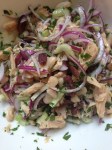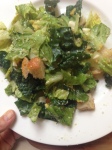
Hail to the Kale Caesar

IMG_7367My son has been insisting I make kale Caesar salad and while loving Ceasar in a restaurant, I haven’t made it before, partly because I wasn’t sure how to deal with the raw eggs. Boy, am I glad he made me look into it as I discovered this delicious, easy-to-make romaine caesar salad which has become an instant classic in our house. Come and cook with us!
While kale is no longer the only superfood that is around, it is still a remarkable food packed with vitamin K, A and C and containing an indirect antioxidant glucosinolates which can reduce levels of harmful estrogens that may promote cancer growth in hormone-sensitive cells. In addition, the romaine lettuce delivers the eye-healthy antioxidant carotenoids beta-carotene, lutein and zeaxanthin which studies have linked to reduced risk of cataracts and age-related macular degeneration. And they are both high in insoluble fiber, which 96% of Americans don’t get enough and could use much more of. In fact, in a French study of 6000 individuals, those with the highest intake of insoluble fiber had lower blood pressure, cholesterol, triglycerides and homocysteine levels. So bring on the Romaine Kale Caesar salad!
The salad mixes romaine and kale which doubles up the nutrition and crispiness of the dish. Instead of using mayo, the dressing uses the ingredients of it but the egg is cooked which can be reassuring for those of us trying to avoid the risks associated with consuming raw eggs. You can go lighter on the anchovies, although I think they provide a depth of flavor that is unmistakably Caesar.
So, if you are like my son and love Caesar salads, give this salad a try and let us know what you think. Come and cook with us!
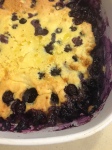
Check for Chickpea(flour)

IMG_7398The fall might be seem like lightyears away, but we have already started to look at delicious, tasty and inviting cookbooks that we hope to sell at our book fair later this year. As you know, I’m always on the lookout for lesser known authors who put extra thoughts into creating recipes for the home chef that are doable on a weeknight while still being nutritious, delicious and satisfying. One such book I really like is Chickpea Flour Does It All by Lindsey S. Love who is also the creator of Dolly and Oatmeal.

Garbanzo – or chickpea flour – is made from finely ground, dried chickpeas. It has all the characteristics I am looking for in a flour: it’s gluten-free, grain-free, low-glycemic, and exceptionally high in protein. While relatively new in Western Cuisine, it has been used for centuries in Mediterranean, Indian and Southeast Asian cooking. I’ve written about making Farinata with chickpea flour before. The reason I prefer it to other more main-stream gluten free flour options is that it has a taste that reminds me of whole wheat flour, which I love. Many of the flour alternatives are just starchy fillers without much flavor. What do you think of it?
This cookbook contains a collection of recipes that focus entirely on this versatile and nutritious ingredient. I’ve tried the Sweet Crepes, the Mango Poppy Seed Cornmeal Muffins and want to share with you a Dutch Baby that was inspired by a recipe in the book. You can whip it up in a jiffy and it bakes while the kids are still waking up. What a perfect way to start these gorgeous summer days. Come and cook with us!
Loving Lentils, Too

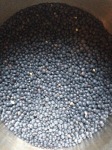
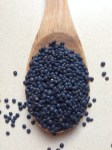
IMG_7176There are certain go-to staples that will always have a place in my heart. Pasta, rice and beans are regularly featured on my menu, however, I tend to look over another great pantry item that has many of the nutritional benefits of beans, is even more versatile and can be made in a much shorter time as it doesn’t require soaking. I’m sure you already know what I’m referring to: let’s give a round of applause to lentils which have been eaten by many civilizations reaching from Asia, to the Medtierranean all the way to our kitchens today! Come and cook with us!
Compared to Jessica’s love for lentils, I didn’t grow up eating dried legumes which is why I seldomly think of them when forming dinner plans which is unfortunate for my husband loves them. Lentils contain many naturally-occurring vitamin Bs and protein for those who wish to consume less animal products. Furthermore, lentils have low glycemic load, act as time-released energy, normalize blood sugar and blood lipids, and are a rich source of fiber, vitamins and minerals. To round out lentils’ virtues, they are loaded with lignans, which help balance hormones naturally. So if this doesn’t convince you, keep in mind that lentils are super easy to cook, versatile in their application and great when added to salads, soups and stews as well as meatloafs and dals.

Inspired by a recent trip to the brilliant Huckleberry Cafe in Santa Monica, we had a delicious lentil stew that was topped with fresh sausages. It all come together so beautifully and deliciously that I wanted to share this dish with all of you. Among the many varieties on the market, I choose black lentils which along with the green (or Le Puy lentils), keep their shape much better than the yellow or orange kinds. We added a steaming heap of polenta to the spread and it was all gone before I even got a chance to offer seconds. Make sure you use good quality sausages as they certainly belong to the food group of “few, but good”.

I hope you give this lentil stew a try! Come and cook with us!

Black Lentil Stew with Sausage

IMG_7173IMG_7176IMG_7185IMG_7186

Learn from the French How to Make Onion Soup

IMG_7110Our society has redefined the way we procure our food. Even if we cook from scratch, few of us have the time, space and skill-set necessary to grow our own produce. I see it as an unfortunate side effect of globalization with my friends and family back home in South Tyrol all still have a garden to rely on. For now, at least. Even my 101-year-old grandmother grows some lettuce, peas, onions and chamomile flowers in a tiny but very productive little patch of garden right in the middle of town. Same for my parents who don’t set foot in a fruit and vegetable store all summer or at least until their supply lasts. Luckily for those of us less active in the gardening department, there is plenty of inspiration to be found to help people find their way back into old-fashioned and proven gardening methods. One such effort stems from our friends across the pond resulting in a beautifully written and illustrated book by renowned chef Raymond Blanc who partnered with London’s spectacular Kew Gardens to publish Kew on a Plate. Let’s see what this book is all about! Come and cook with us!

If it wasn’t for David, my friend, neighbor and fellow European (at least until Brexit is decided), I wouldn’t have discovered this book which is currently out of stock in the US. For those not familiar with Raymond Blanc, he is a renowned French chef whose restaurant holds 2 Michelin Stars. He is also a successful author and has presented several BBC series. To give you a hint on why both David and I appreciate Raymond’s approach to cooking, the best dish on his menu, according to himself, is the ‘one that’s in season’. You can see why having access to Kew Gardens turned him into a kid in a candy store. Furthermore, he worked with the garden staff to grow exactly those varieties of produce that yield the highest flavor. And he knows a thing or two about that topic!

In his book, the restaurateur selects a variety of specific fruits and vegetables from carrots to potatoes, rhubarb and gooseberries, apples and peas, and offers tips and expertise in growing the produce, adding flavor notes as well as sharing about 40 mouth-watering recipes including a tasty chicory gratin and a gorgeous spring pea risotto that makes my mouth water.

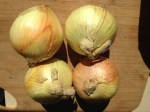
Many of the featured dishes are not just super delicious, they look particularly delectable. I’ve chosen this classic mid-week French Onion Soup to showcast how simple ingredients come together beautifully when prepared the right way. And who is better to offer advice on that than Raymond Blanc! Give it a try and let me know what you think. Come and cook with is!

Classic French Onion Soup

IMG_7098IMG_7102IMG_7104IMG_7107IMG_7106-1

Cooking with the Seasons – Tuscan Tuna Salad

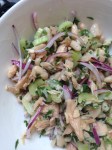
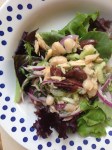
IMG_6734The longer I live in California, the more I appreciate the year-round accessibility to fresh produce. We are supposed to eat with the seasons and this leaves you with plenty of options if you can call this place your home. The one thing that doesn’t change, however, is that I cook with the seasons. Meaning that I follow my intuition on which warming or cooling foods my body craves depending on the environment around us. In the macrobiotic diet this is called the Yin (summer style) and Yan (winter style) of cooking styles. So now that the hot climate is around the corner, we welcome spring with a slew of fresh salads that keep us cool while still be filling and satisfying. My current favorite is this Tuscan Tuna and White Bean Salad inspired by the restaurant fish in Sausalito. Come and cook with us!

There is no one-size-fits-all when it comes to nutrition but I like to think that one can take ideas and inspiration from different sources. The belief that there are expansive and contractive foods and cooking styles is something that speaks to me. Don’t you agree that eating a hot comfort dish makes you feel warmer inside while you probably crave something more refreshing and light to cool you off when it is warm? Here are a few cooking style ideas based on Kristina Turner, author of The Self-Healing Cookbook, a macrobiotic primer for heating body, mind and moods with whole, natural foods. It was originally published in 1987 but to me her theories still hold true. She even included a chapter on why eating organic produce makes a difference. Talk about being ahead of the curve.

But back to seasonal cooking styles. In warm weather, Turner suggests the following:

  • Steam, quick-boil or make salads
  • Serve cool or at room temperature
  • Eat lighter-more upward growing foods
  • Choose soft, leafy greens
  • Use less salt
  • Enhance with vinegar, lemon, fresh ginger, parsley or other fresh herbs

When it comes to the colder winter months, Turner says this:

  • Slow-simmer, pressure cook, bake or sauté
  • Serve warm
  • Eat hearty – more compact veggies and downward growing roots
  • Choose sturdy, leafy greens
  • Add a little sea salt, miso, tamari or sauerkraut
  • Enhance with green onion, sea vegetables, ginger or dried herbs

With this as a back-drop, there are plenty of easy, fresh and colorful salads that inspire me this time of year. To bridge this transitional period when days are hot and evenings are cold, I’d like to share a salad that is both refreshing but also hearty, and clearly not very macrobiotic: Tuscan Tuna and White Bean Salad. It’s crunchy in texture, decisive in flavor and made in a jiffy. And while it’s certainly not something I make all the time – being contentious about eating tuna – sometimes we just have to listen to our bodies and prepare what it is calling out for. Hope you like the salad as much as we do. Come and cook with us!

Tuscan Tuna and White Bean Salad

IMG_6727IMG_6729IMG_6732IMG_6737IMG_6734